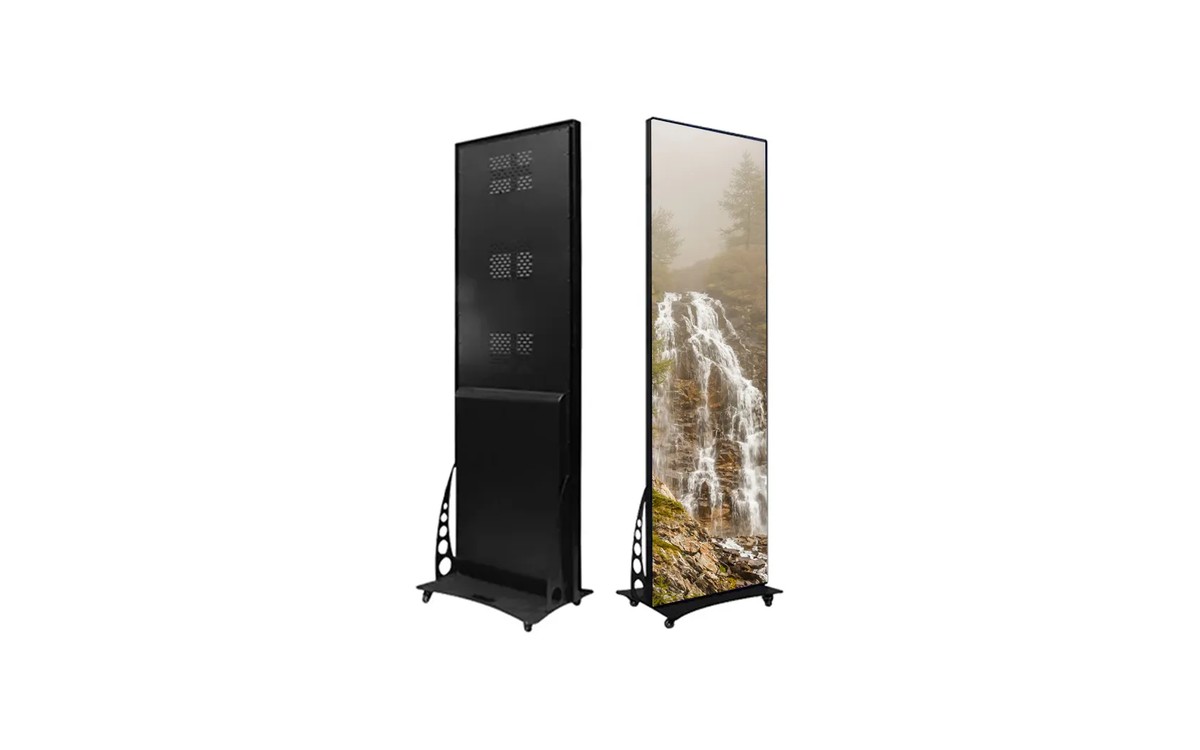
Poster displays sell for a different reason than video walls: they are furniture-scale, movable and content-driven. A store can change a promotion in the morning without calling an installer.
What 640×1920 actually gives you
The 1:3 canvas suits portrait content: product posters, menus, wayfinding, fashion campaigns. At P1.86 the panel carries about 344×1,032 pixels; at P2.5, 256×768. The second number matters — 768 pixels is exactly 720p plus margin, so 1080p content is downscaled and text must be sized accordingly.
Brightness and placement
900 nits is designed for indoor retail lighting, not direct sunlight. In a shop window facing the street, expect to compete with daylight: the poster reads well from 2–3 m inside the glass but washes out in direct sun. For window-facing installations, a high-brightness version or a transparent screen is usually the better answer.
Content control and updating
Most posters run from a built-in player with USB or network scheduling. Ask three questions: can content be updated remotely, can multiple posters be grouped into one schedule, and what happens after a power cut. A poster that needs a site visit to change a price is a printed poster with extra steps.
| Setting | Fit | Note |
|---|---|---|
| Retail floor | Strong | 900 nits handles indoor lighting |
| Shop window in sun | Weak | Washed out; consider high-brightness |
| Hotel lobby | Strong | Quiet, movable, no structure |
| Exhibition stand | Strong | Rapid content changes, easy transport |
Installation and safety
At 40 kg, a poster is movable by two people but should be anchored or weighted in public areas. Check the base design, wheel locks and whether the panel can be serviced without laying the unit down. Cable routing matters in retail: a loose cable is a trip hazard and an insurance question.
Designing content for a 1:3 canvas
Most poster content is designed for 16:9 and then squeezed, which is why so many posters look like stretched video. Design natively at 640×1920: a single product, a short headline, a price or a QR code. Text below about 40 px on the canvas becomes unreadable at 2–3 m, which is roughly a 14 mm cap height on the physical panel.
Motion should be slow. A poster is viewed for two to five seconds while someone walks past, so a 10-second loop with one transition works better than a fast carousel. Keep a safe margin of 40–60 mm at the edges for the frame and avoid critical content near the bottom where furniture or stock may block the view.
Network, power and daily operation
A poster needs a power socket and, if content is updated remotely, a network connection — Wi-Fi is usually enough, but retail Wi-Fi is often restricted. Confirm whether the player supports 4G or LAN as a fallback. Scheduling should survive a power cut: the player must restart and resume the last schedule without a site visit.
For chains and exhibitions, grouping matters more than resolution. Being able to push one campaign to twenty posters in five locations, with different time zones and opening hours, is the operational feature that decides whether the fleet is manageable. Ask for a demonstration of the content platform, not a brochure.
Poster versus printed poster over three years
A printed poster needs design, print, shipping and someone to change it. A digital poster needs power, content and occasional service. For a store changing promotion monthly, the digital unit usually pays back within a year; for a poster that changes twice a year, print is often cheaper.
The comparison should include the hidden costs of print: storage of old stock, waste, and the labour to install. Digital adds electricity and a content workflow, which is where most operational failures happen — not in the panel.
Rental posters for exhibitions
Exhibition organisers increasingly rent posters rather than print boards: the unit arrives in a flight case, rolls in, plugs in and is collected after the show. If you plan to rent, check the case design, the weight for one-person handling, and whether the base collapses for transport. A 40 kg poster is movable, but not convenient on stairs without a case with wheels.
FAQ
About 344×1,032 pixels at P1.86, or 256×768 at P2.5. Content should be authored for the portrait canvas.
For indoor-facing placement yes. In direct sunlight the image washes out; a high-brightness version or a transparent screen is better for window-facing use.
Yes, with network or cloud scheduling. Confirm grouping, scheduling and offline behaviour before ordering.
About 40 kg. Two people should move it; the base usually has castors but should be anchored in public areas.
No. It stands on its own base and needs a standard power socket, which is why it suits leased retail spaces.
See the Poster-L 640×1920 series or the LED poster display range for specifications and options.
Per square metre of screen, with cabinets, control system, structure, installation and spare parts scoped separately. The LED wall price guide explains the five cost drivers and why two quotes for the same pitch can differ.