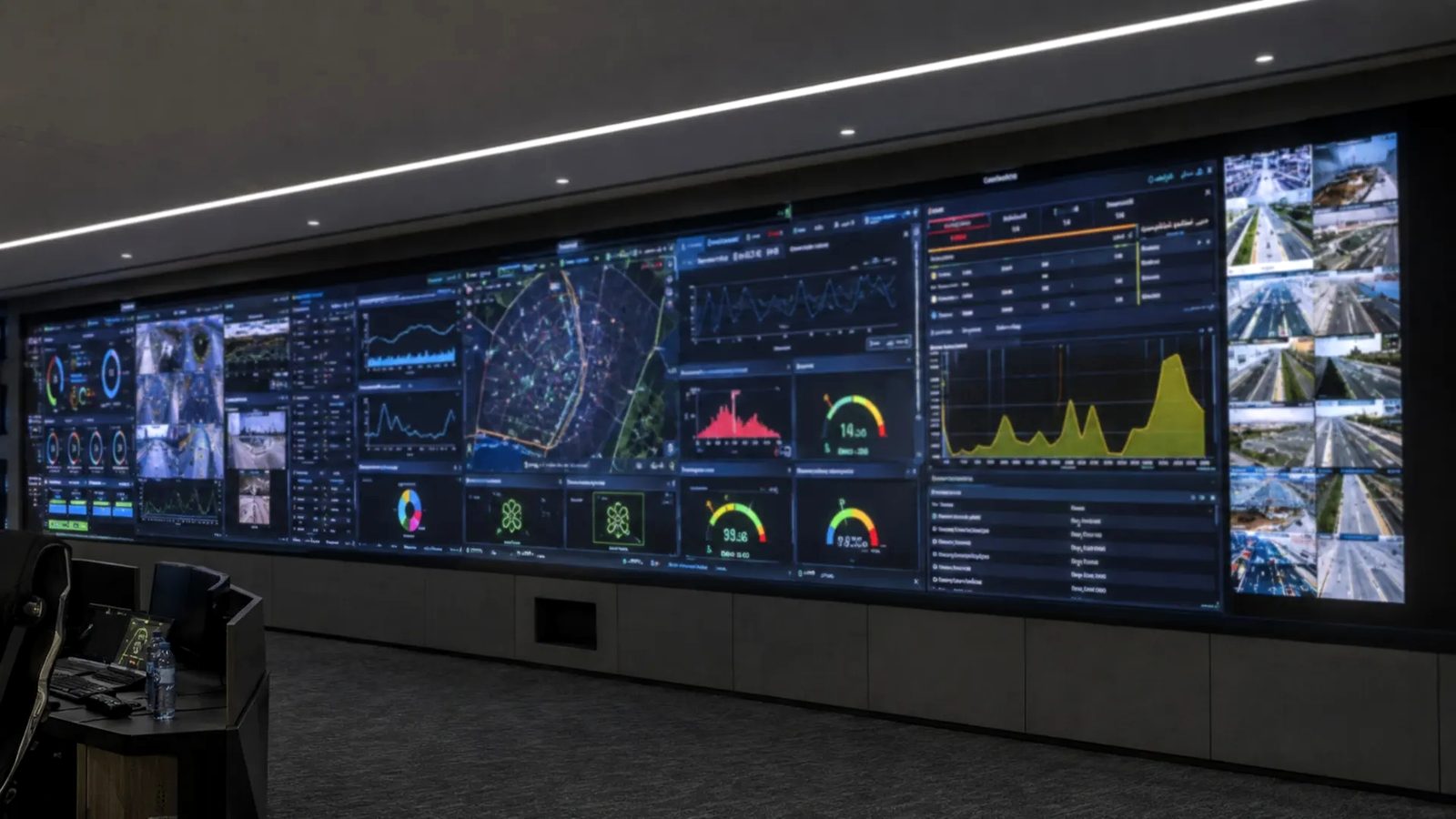
Fine pitch is where LED starts competing with LCD video walls. COB packaging seals the LEDs under a protective layer, which improves durability and contrast but changes how the panel is repaired and how heat leaves the module.
What P1.25 means in practice
At 1.25 mm pitch, a 600×337.5 mm cabinet carries 480×270 pixels; a 1.2 × 0.675 m block gives 960×540. That is the number to design content against — a 1080p canvas needs roughly 1.35 × 0.76 m of P1.25, which is why fine pitch suits meeting rooms rather than large halls.
COB vs SMD at this pitch
At P1.25, SMD lamps are small and fragile; COB seals them, improving resistance to touch and cleaning. The trade-off is repair: a failed COB module is usually replaced as a unit, while SMD allows lamp-level repair. For a boardroom, replacement is fine; for a 24/7 control room, spare modules and a fast swap procedure matter more than lamp-level repair.
Heat, power and noise
Fine pitch concentrates LEDs and drivers in a small area, so heat density is higher. A P1.25 wall typically draws 300–500 W per square metre at peak, but the heat is concentrated behind the panel. Passive cooling keeps the room quiet; fan-assisted designs need airflow space behind the wall. In a boardroom, noise is a specification item, not a detail.
| Setting | P1.25 fit | Check |
|---|---|---|
| Boardroom 3–5 m | Strong | Heat and fan noise |
| Control room 1.5–3 m | Strong | 24/7 duty and spares |
| Lobby wall 6 m+ | Overkill | P1.86–P2.5 is cheaper |
| Broadcast studio | Good | Refresh and camera test |
Installation and service
Fine pitch walls are usually front-service to keep the wall flush. That means modules are removed from the front with a tool, and the wall needs a flat, aligned substrate. Any unevenness shows as a seam at this pitch, so the mounting system matters as much as the cabinet.
Flatness, seams and the mounting system
At P1.25, a 0.3 mm step between cabinets is visible as a dark line on a white slide. Fine pitch walls are therefore installed on a surveyed substrate with adjustable mounts, and the cabinets are aligned after hanging rather than before. Ask how the mounting system adjusts in three axes, and how flatness is measured on site — a straight edge and a feeler gauge, not a visual check.
Seams also appear over time if the wall is mounted on a structure that moves, such as a partition wall or a floor above a plant room. In that case, a floating frame with vibration isolation is worth discussing before installation, not after the first complaint.
Cost, lifetime and the honest comparison with LCD
Fine pitch LED costs more per square metre than an LCD video wall at the same size, but it has no bezels, no panel replacement lottery and a longer nominal lifetime. The real comparison is total cost over five years: LCD panels are replaced in blocks when a tile fails, while LED modules are replaced individually. For a boardroom used daily, LED usually wins; for a temporary installation, LCD rental may be cheaper.
Ask for the module lifetime figure at the drive settings used, the power consumption at the brightness you will actually run, and the spare-parts lead time. Those three numbers decide the five-year cost more than the purchase price.
Common COB wall sizes and resolutions
Fine pitch walls are usually sized to a content standard — 1080p, 4K, or a video-conference format. Working backwards from the canvas prevents a wall that cannot display native content.
| Wall size | Pixels at P1.25 | Matches |
|---|---|---|
| 1.2 × 0.675 m | 960 × 540 | Quarter HD |
| 2.4 × 1.35 m | 1,920 × 1,080 | Full HD |
| 2.4 × 2.7 m | 1,920 × 2,160 | Vertical Full HD |
| 4.8 × 2.7 m | 3,840 × 2,160 | 4K UHD |
Spec sheet items worth demanding
Five numbers separate a good fine-pitch quote from a vague one: brightness at the drive settings you will use, power consumption at that brightness, module flatness tolerance, cabinet adjustment range in three axes, and the duty cycle the power supplies are rated for. Ask for them in writing — a datasheet that only lists maximum brightness tells you nothing about how the wall behaves in a meeting room at 60% output.
FAQ
About 1.5–2.5 m for critical content; beyond 4 m the benefit over P1.86 is hard to see.
COB is more durable and higher contrast; SMD allows lamp-level repair. The right choice depends on duty cycle and service model.
Typically 300–500 W per square metre at peak, with concentrated heat behind the panel.
Yes with the right power supplies and cooling design; specify the duty cycle in the quote.
Yes — a flat, aligned mounting surface. Unevenness is visible at this pitch.
Review the COB-H fine pitch series or the fine pitch LED range.
Per square metre of screen, with cabinets, control system, structure, installation and spare parts scoped separately. The LED wall price guide explains the five cost drivers and why two quotes for the same pitch can differ.