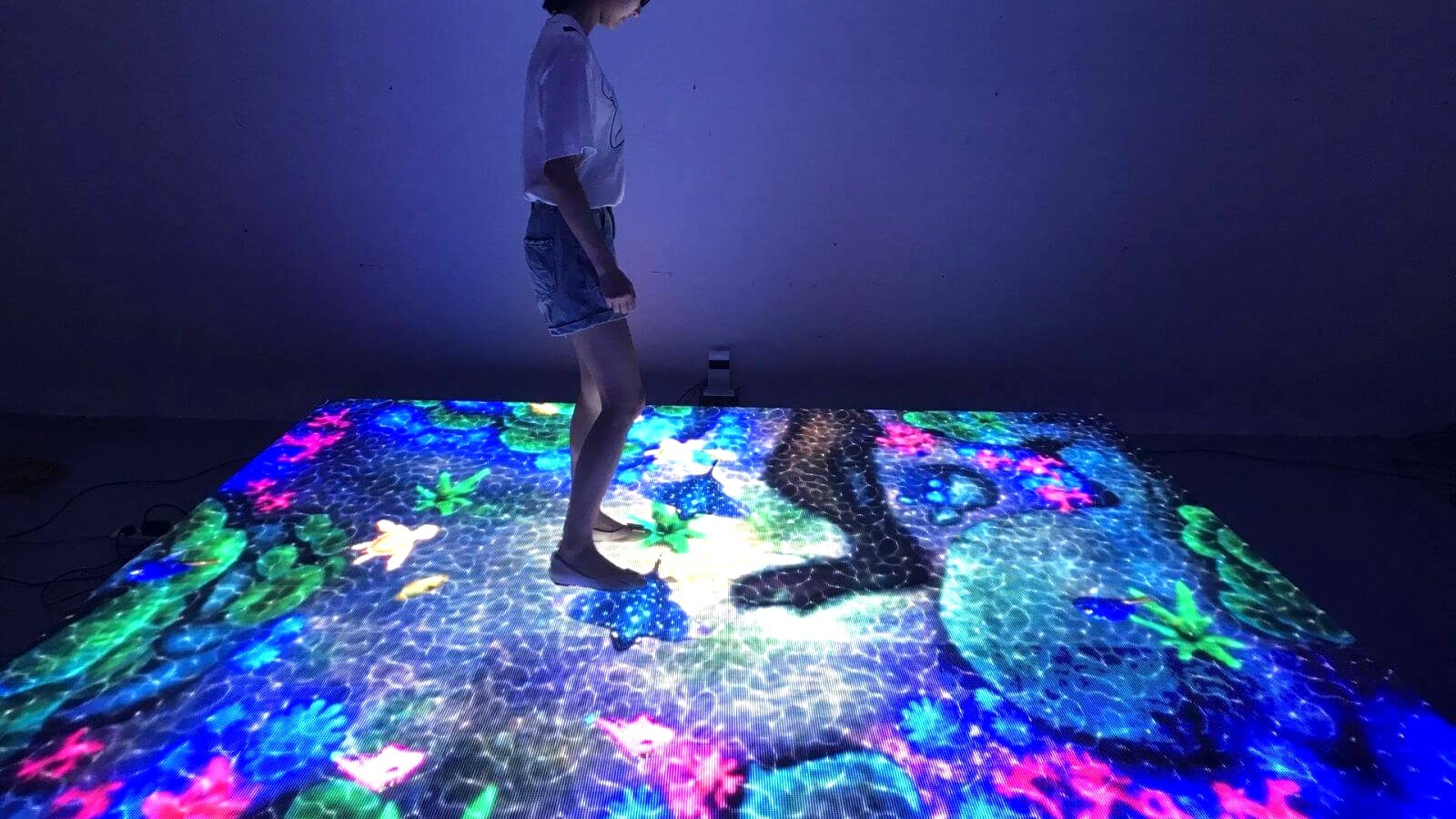
Floor screens fail for physical reasons far more often than electronic ones: a weak frame, a slippery surface, or modules that cannot be replaced without lifting half the floor. Buyers who start with the LED pitch usually ask the wrong questions first.
Load rating and structure
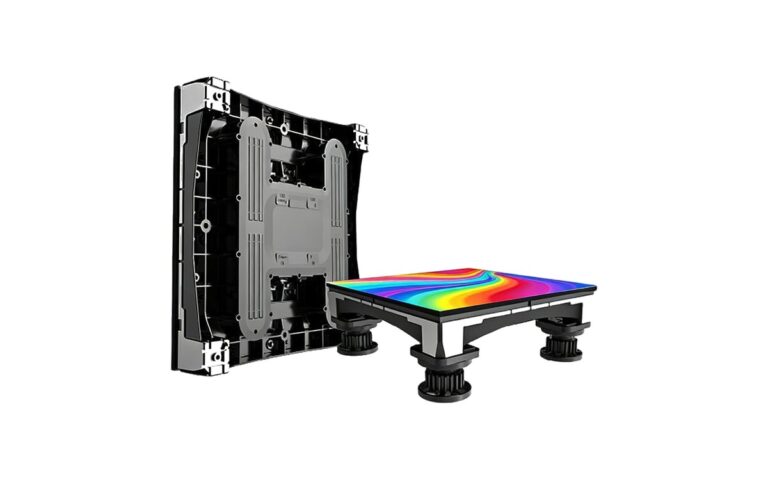
1,500 kg/m² covers crowds, stage equipment and the occasional vehicle at walking speed. The number applies to a properly supported floor: the modules sit in a load-bearing frame on a flat substrate. On uneven ground, point loads concentrate and the rating no longer holds. Ask for the frame design and the maximum point load, not just the area figure.
Surface and safety
Interactive floors are walked on with shoes, heels and occasionally drinks. The surface needs an anti-slip mask, sealed edges and a cleanable top layer. Glossy surfaces look better in photos and are more dangerous in reality. Ask for the anti-slip rating and how the surface is cleaned without damaging the mask.
Interaction: sensors vs camera tracking
Two common approaches: pressure/capacitive sensors under the modules, or overhead camera tracking that maps people onto the screen. Camera tracking supports multi-person interaction and larger areas but needs a clear overhead view and calibration. Sensors are simpler and more robust but limited in resolution and interactivity type. Decide the interaction concept before choosing the floor, because it changes the module and control layout.
| Requirement | Typical answer | Verify |
|---|---|---|
| Crowd walking | 1,500 kg/m² rated frame | Point load and substrate |
| Dance / performance | Higher-impact surface mask | Warranty terms for impact |
| Multi-person interaction | Camera tracking | Ceiling height and calibration |
| Fast service | Front-access modules | Replacement time per tile |
Serviceability decides the lifecycle
A floor tile that fails in the middle of an event needs a fast swap. Ask how a single module is removed, whether the frame stays in place, and how many spare tiles should be kept. For rental use, a 5% spare ratio is a reasonable starting point; for permanent installations, spare modules and a documented replacement procedure matter more than the spare count.
Substrate and installation sequence
Floor modules sit in a frame that must be fully supported. On a concrete slab, a self-levelling layer is usually enough; on a raised floor or stage deck, the frame needs to span between supports and the deck must be rated for the point loads. Installation runs edge to edge with a consistent gap, and the whole floor is usually installed in one direction so that any height difference is spread rather than concentrated.
Edge treatment matters in public spaces: ramps or trim pieces prevent trip hazards and protect the first row of modules from trolleys and heels. If the floor is temporary, the frame design should allow fast assembly without tools that damage the venue floor.
Content, tracking software and event day
Interaction content is usually built in a game engine or a dedicated floor application. The critical questions are calibration time, how many simultaneous participants are supported, and what happens when someone stands still on a sensor for a long period. A demo that runs for two minutes in a showroom can behave differently under 200 people for six hours.
For event day, keep a spare tile, a spare power supply and a laptop with the project file and the calibration profile. Most floor failures we see are not LED failures — they are calibration drift, a loose data cable, or a laptop that was never backed up.
Common floor sizes and tile counts
Floor projects are quoted by tile count, not square metres, because the frame is modular. A 500×500 mm module gives four tiles per square metre.
| Floor area | Tiles (500×500) | Typical use |
|---|---|---|
| 3 × 2 m | 24 | Retail activation |
| 5 × 3 m | 60 | Event entrance |
| 8 × 4 m | 128 | Stage front or exhibition |
| 10 × 6 m | 240 | Large venue installation |
Rental floor logistics
A rental floor travels in cases, and the cases are often bulkier than the tiles. For a 5 × 3 m floor, plan for 4–6 cases plus the frame and a spare tile box. Setup time depends on the frame system: tool-free frames are faster but cost more; bolted frames are cheaper but slower and need torque control. Ask for a setup video and time a small section before committing to a tour.
FAQ
Around 1,500 kg/m² on a proper substrate with a rated frame. Point loads and uneven ground reduce the safe figure.
Either sensors under the modules or overhead camera tracking. The choice affects layout, calibration and cost, so decide it before ordering.
Good floors use an anti-slip mask. Ask for the rating and test a sample with the shoes used at the venue.
Front-access designs allow it. Confirm the procedure and keep spare tiles matched to the batch.
P2.5–P6.25 depending on viewing distance and interaction style. Floor content is usually viewed from above, so pitch matters less than load and surface.
Review the Floor-R interactive series or the floor LED display range for module and frame details.
Per square metre of screen, with cabinets, control system, structure, installation and spare parts scoped separately. The LED wall price guide explains the five cost drivers and why two quotes for the same pitch can differ.